Full Stack Development

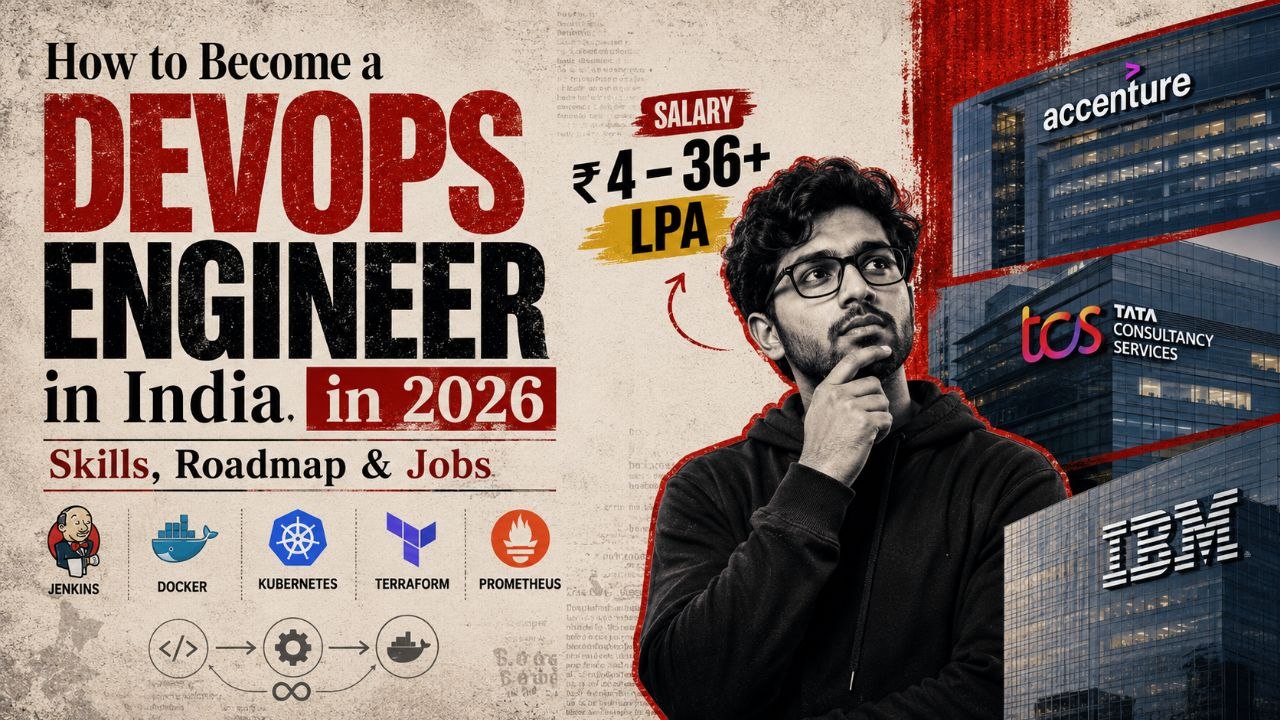
How to Become a DevOps Engineer in India in 2026: Skills, Roadmap & Jobs

kuldeep kumar kuldeep kumar
Aug 12, 2026 11 Min Read

Career Guide • Updated for 2026

How to Become a DevOps Engineer in India in 2026: Skills, Roadmap, Salary & Jobs

Learn the complete DevOps Engineer roadmap for 2026, including Linux, Git, networking, Docker, Kubernetes, CI/CD, cloud, Terraform, monitoring, projects, salary and fresher jobs.

Modern software teams need to build, test and release applications quickly while keeping them reliable and secure. This is where DevOps plays an important role.

DevOps combines development, operations, automation, infrastructure and collaboration to create faster and more reliable software delivery processes.

As cloud computing, containers, automation and platform engineering continue to evolve, DevOps remains an important career path for people who enjoy Linux, cloud infrastructure, automation, networking and software engineering.

💡 What does a DevOps Engineer actually do?

A DevOps Engineer helps development and operations teams build automated systems for testing, deploying, monitoring and maintaining software applications.

DevOps Engineer roadmap, tools and cloud infrastructure in 2026

If you are wondering how to become a DevOps Engineer in India, this guide will take you from the fundamentals to the skills, tools and projects that can help you prepare for DevOps roles.

📌 What You'll Learn

  • What is DevOps?
  • What does a DevOps Engineer do?
  • DevOps vs Cloud Engineer vs SRE
  • Skills required to become a DevOps Engineer
  • Linux and networking fundamentals
  • Git and GitHub
  • Docker and containers
  • Kubernetes
  • CI/CD pipelines
  • Cloud computing
  • Terraform and Infrastructure as Code
  • Monitoring and observability
  • Complete DevOps roadmap for beginners
  • DevOps roadmap for freshers
  • Best DevOps projects
  • DevOps salary in India
  • How to get a DevOps job
  • Frequently asked questions

What Is DevOps?

DevOps is a set of practices, tools and working principles that help development and operations teams collaborate to build, test, release and operate software more efficiently.

The main goal is not simply to learn a list of tools. DevOps focuses on improving the entire software delivery process through automation, collaboration, feedback, reliability and repeatable workflows.

Plan → Code → Build → Test → Release → Deploy → Operate → Monitor

A simplified DevOps software delivery lifecycle

What Does a DevOps Engineer Do?

A DevOps Engineer's exact responsibilities vary by organization, but common responsibilities include:

  • Managing Linux-based environments
  • Automating development and deployment workflows
  • Building CI/CD pipelines
  • Managing cloud infrastructure
  • Working with containers
  • Managing Kubernetes environments
  • Using Infrastructure as Code
  • Monitoring applications and infrastructure
  • Improving system reliability
  • Managing logs and alerts
  • Automating repetitive operational tasks
  • Collaborating with developers and security teams
🎯 In simple words:

A DevOps Engineer helps turn “code written by developers” into “reliable software running in production.”

DevOps Engineer vs Cloud Engineer vs SRE

These roles overlap, but their primary areas of responsibility can be different.

Role Primary Focus Common Skills
DevOps Engineer Automation, deployment and software delivery Linux, Git, CI/CD, Docker, Cloud, Kubernetes
Cloud Engineer Cloud infrastructure and services AWS/Azure/GCP, Networking, IaC, Security
SRE Reliability, availability and operational excellence Monitoring, Automation, Cloud, SLOs, Incident Response
Platform Engineer Internal developer platforms and self-service infrastructure Cloud, Kubernetes, IaC, Automation, Platform Tools

Is DevOps a Good Career in India in 2026?

Yes. DevOps remains a relevant career path because organizations continue to depend on cloud infrastructure, automated deployment, containers, observability and reliable software delivery.

Current 2026 roadmap discussions continue to emphasize Linux, Git, Docker, Kubernetes, CI/CD, cloud platforms, Infrastructure as Code, monitoring and real-world projects. :contentReference[oaicite:2]{index=2}

🐧
Linux
☁️
Cloud
🐳
Containers
⚙️
Automation
DevOps tools including Docker Kubernetes CI CD cloud and automation

Skills Required to Become a DevOps Engineer

You do not need to learn every DevOps tool at the same time. Start with fundamentals, then progress toward automation, cloud, containers, orchestration and production systems.

1. Linux Fundamentals

Linux is an important foundation for many DevOps environments.

Learn:

  • File system and directories
  • File permissions
  • Processes
  • Users and groups
  • SSH
  • Package management
  • Environment variables
  • Shell commands
  • Basic Bash scripting
🎯 Beginner Tip:

Do not just memorize Linux commands. Use Linux regularly while building and deploying projects.

2. Networking Basics

A DevOps Engineer should understand how applications communicate across networks.

  • IP addresses
  • DNS
  • HTTP and HTTPS
  • Ports
  • TCP/IP basics
  • Firewalls
  • Load balancing
  • Reverse proxies
  • Basic subnetting

3. Git and GitHub

Git is fundamental for modern software development and DevOps workflows.

Learn:

  • Repository management
  • Clone
  • Commit
  • Push and Pull
  • Branches
  • Merge
  • Pull Requests
  • Tags and releases
  • Basic Git workflows

4. CI/CD

Continuous Integration and Continuous Delivery/Deployment help teams automate software testing and delivery.

Code → Build → Test → Package → Deploy → Monitor

Common CI/CD tools include platforms and systems such as GitHub Actions, Jenkins, GitLab CI/CD and similar automation services.

5. Docker and Containers

Docker helps package applications and their dependencies into portable containers.

Learn:

  • Images
  • Containers
  • Dockerfiles
  • Volumes
  • Networks
  • Docker Compose
  • Container registries

Application + Dependencies → Container → Deployment

6. Kubernetes

Kubernetes is a major container orchestration platform used to manage containerized applications at scale.

Start with:

  • Pods
  • Deployments
  • Services
  • ConfigMaps
  • Secrets
  • Namespaces
  • Ingress
  • Scaling basics
  • Rolling updates

Do not try to memorize every Kubernetes object. Focus on understanding why orchestration is needed and how applications are deployed and exposed.

7. Cloud Computing

Choose one major cloud platform and learn it properly instead of trying to master all three simultaneously.

AWS   |   Microsoft Azure   |   Google Cloud

Pick one platform first and build real projects with it.

Understand compute, storage, networking, IAM, databases, load balancing and monitoring fundamentals.

8. Infrastructure as Code with Terraform

Infrastructure as Code allows infrastructure to be managed using configuration files rather than manually creating every resource.

Terraform is a widely used Infrastructure as Code tool.

Learn:

  • Providers
  • Resources
  • Variables
  • Outputs
  • State
  • Modules
  • Plan and Apply workflow

9. Monitoring and Observability

Deploying an application is not the end of the DevOps process. You also need to know whether it is healthy and performing properly.

Learn the basics of:

  • Metrics
  • Logs
  • Traces
  • Alerts
  • Dashboards
  • Application health checks

Tools and platforms can include Prometheus, Grafana, cloud monitoring services and centralized logging systems.

10. Security Basics

Modern DevOps roles increasingly require security awareness throughout the development and deployment lifecycle.

  • Secrets management
  • Least-privilege access
  • Secure configurations
  • Dependency security
  • Container security basics
  • Identity and access management

🚀 Complete DevOps Engineer Roadmap for 2026

If you are starting from scratch, follow this progression instead of jumping directly into Kubernetes or advanced cloud architecture.

STEP 01 — Learn Linux

STEP 02 — Learn Networking Basics

STEP 03 — Learn Git and GitHub

STEP 04 — Learn Bash / Scripting Basics

STEP 05 — Learn CI/CD

STEP 06 — Learn Docker

STEP 07 — Learn One Cloud Platform

STEP 08 — Learn Kubernetes

STEP 09 — Learn Terraform and Monitoring

STEP 10 — Build Real Projects and Prepare for Jobs

DevOps Roadmap for Freshers

Freshers often make the mistake of learning too many tools without developing strong fundamentals.

Linux → Networking → Git → CI/CD → Docker

→ Cloud → Kubernetes → Terraform → Monitoring → Projects

You do not need to become an expert in every tool before applying for internships or entry-level roles. Build a strong foundation and demonstrate your skills through projects.

💻 Best DevOps Projects for Your Portfolio

Project 1: CI/CD Pipeline for a Web Application

Take a simple web application and build an automated pipeline that runs tests, builds the application and deploys it after successful checks.

GitHub → Build → Test → Docker → Deploy

Project 2: Dockerize a Full Stack Application

Containerize the frontend, backend and supporting services using Docker and Docker Compose.

Project 3: Kubernetes Deployment

Deploy a containerized application on Kubernetes and configure deployments, services, secrets and basic scaling.

Project 4: Infrastructure as Code Project

Use Terraform to create cloud infrastructure instead of configuring every resource manually.

Project 5: Monitoring and Observability Project

Deploy an application and build dashboards, metrics, health checks and alerts using a monitoring stack.

⭐ Portfolio Tip

Do not simply write “Docker, Kubernetes and AWS” on your resume. Show an actual system such as “Built and deployed a containerized application using Docker, Kubernetes and a CI/CD pipeline.”

90-Day DevOps Learning Plan for Beginners

Time Focus Goal
Days 1–20 Linux + Networking + Git Strong fundamentals
Days 21–40 CI/CD + Docker Build automated deployment workflows
Days 41–60 Cloud fundamentals Deploy applications on cloud
Days 61–75 Kubernetes Deploy and manage containers
Days 76–90 Terraform + Monitoring + Projects Create a job-ready portfolio

💰 DevOps Engineer Salary in India in 2026

DevOps Engineer compensation varies significantly based on experience, location, company, cloud expertise, technical depth and the responsibilities of the role.

Salary information should therefore be treated as indicative rather than guaranteed. Before quoting a number to candidates, compare current job listings and reputable salary datasets for the relevant role and location.

Career Stage Typical Factors High-Value Skills
Fresher / Entry Level Internships, projects, location, company Linux, Git, Docker, Cloud, CI/CD
Mid-Level Production ownership and specialization Kubernetes, Terraform, Cloud, Monitoring
Senior Architecture, scale and leadership Platform Engineering, Reliability, Security, Architecture

Salary note: Compensation varies widely between companies and locations. Use current job listings and salary databases for precise market comparisons.

How to Get a DevOps Job as a Fresher

  1. Build strong Linux and networking fundamentals.
  2. Learn Git and CI/CD.
  3. Build Docker-based projects.
  4. Learn one cloud platform.
  5. Learn Kubernetes fundamentals.
  6. Use Terraform in at least one project.
  7. Create a GitHub portfolio with architecture diagrams and README files.
  8. Prepare for interviews around Linux, networking, Docker, CI/CD, cloud and troubleshooting.
🎯 Resume Rule:

Do not claim expertise in tools you have only watched tutorials about. Be prepared to explain exactly what you built, why you chose the tool, how it worked and what problems you solved.

Are DevOps Certifications Necessary?

Certifications can be useful, especially for demonstrating structured knowledge of cloud platforms or specific technologies, but they should not replace practical skills.

For beginners, a better sequence is:

Learn → Build → Deploy → Troubleshoot → Document → Certify if Useful

DevOps Interview Topics to Prepare

Once you have the fundamentals, prepare for questions around:

  • Linux commands and troubleshooting
  • Networking and DNS
  • Git workflows
  • CI/CD concepts
  • Docker containers
  • Kubernetes basics
  • Cloud services
  • Terraform and Infrastructure as Code
  • Monitoring and logging
  • Incident troubleshooting
  • Security basics

DevOps Engineer Career Growth

Junior DevOps Engineer

DevOps Engineer

Senior DevOps Engineer

Lead / Platform Engineer / SRE

As your experience grows, you can specialize in areas such as:

  • Cloud Engineering
  • Site Reliability Engineering
  • Platform Engineering
  • DevSecOps
  • Cloud Infrastructure
  • Infrastructure Architecture
  • Developer Platforms

Frequently Asked Questions

What is DevOps?

DevOps is a combination of practices, tools and collaboration principles designed to improve software development, delivery, deployment and operations.

Can a fresher become a DevOps Engineer?

Yes. Freshers can start by learning Linux, networking, Git, CI/CD, Docker, cloud fundamentals and then building practical projects.

Is coding required for DevOps?

DevOps does not usually require the same level of application coding as a software development role, but scripting and programming fundamentals are very useful for automation.

Which programming language should a DevOps beginner learn?

Python and Bash are practical choices for automation and scripting. You do not need advanced programming knowledge before starting with DevOps fundamentals.

Is Docker necessary for DevOps?

Docker and container concepts are highly useful because containerized applications are common in modern development and deployment workflows.

Is Kubernetes necessary for a DevOps Engineer?

Kubernetes is valuable for many modern DevOps and platform roles, but beginners should first understand Linux, containers and deployment fundamentals before learning Kubernetes deeply.

Should I learn AWS or Azure for DevOps?

Choose one cloud platform first. AWS, Azure and Google Cloud are all useful; the best starting choice depends on the companies and roles you want to target.

Is Terraform necessary for DevOps?

Terraform is not the only Infrastructure as Code tool, but learning IaC concepts and getting hands-on with Terraform can be valuable for modern infrastructure roles.

How long does it take to learn DevOps?

The timeline depends on your existing technical background and how much time you can practice. Instead of targeting a fixed number of days, focus on becoming comfortable with fundamentals and building real projects.

What projects should a DevOps fresher build?

Strong portfolio projects include a CI/CD deployment pipeline, a Dockerized application, a Kubernetes deployment, a Terraform infrastructure project and a monitoring/observability setup.

Final Thoughts

Becoming a DevOps Engineer in 2026 is not about memorizing the largest possible list of tools. It is about understanding how modern software is built, tested, deployed, monitored and maintained.

Start with Linux, networking and Git, then progress to CI/CD, Docker, cloud, Kubernetes, Terraform and monitoring.

Linux → Networking → Git → CI/CD → Docker

→ Cloud → Kubernetes → Terraform → Monitoring → Projects

The most valuable step is to build real systems and learn how to troubleshoot them. A strong portfolio, practical knowledge and consistent interview preparation can put you on a much better path toward a DevOps career in India.