AI & Machine Learning Engineering Course
Bridge the gap between experimental research and production systems. Master PyTorch tensor programming, distributed training, model quantization with TensorRT, feature store architecture, and end-to-end continuous training with Kubeflow.
Get Expert Course Guidance
Speak with a Principal Architect & get a customized roadmap, syllabus, and 0% EMI plans.
From Notebook Prototypes to Enterprise ML Platforms
Over 80% of machine learning models fail to reach production because typical training focuses on scikit-learn fit/predict rather than distributed infrastructure, latency tuning, and automated deployment.
Enterprise Bottlenecks in 2026
Modern engineering teams require engineers who can solve production infrastructure challenges:
- Data & Feature Skew: Maintaining consistent features between offline training batches and online real-time inference.
- Inference Bottlenecks: Optimizing heavy neural networks to execute within sub-50ms SLA on constrained hardware.
- Silent Model Degradation: Detecting concept drift and statistical distribution shifts before they impact revenue.
What You Will Engineer
This program builds end-to-end competencies across the full production lifecycle:
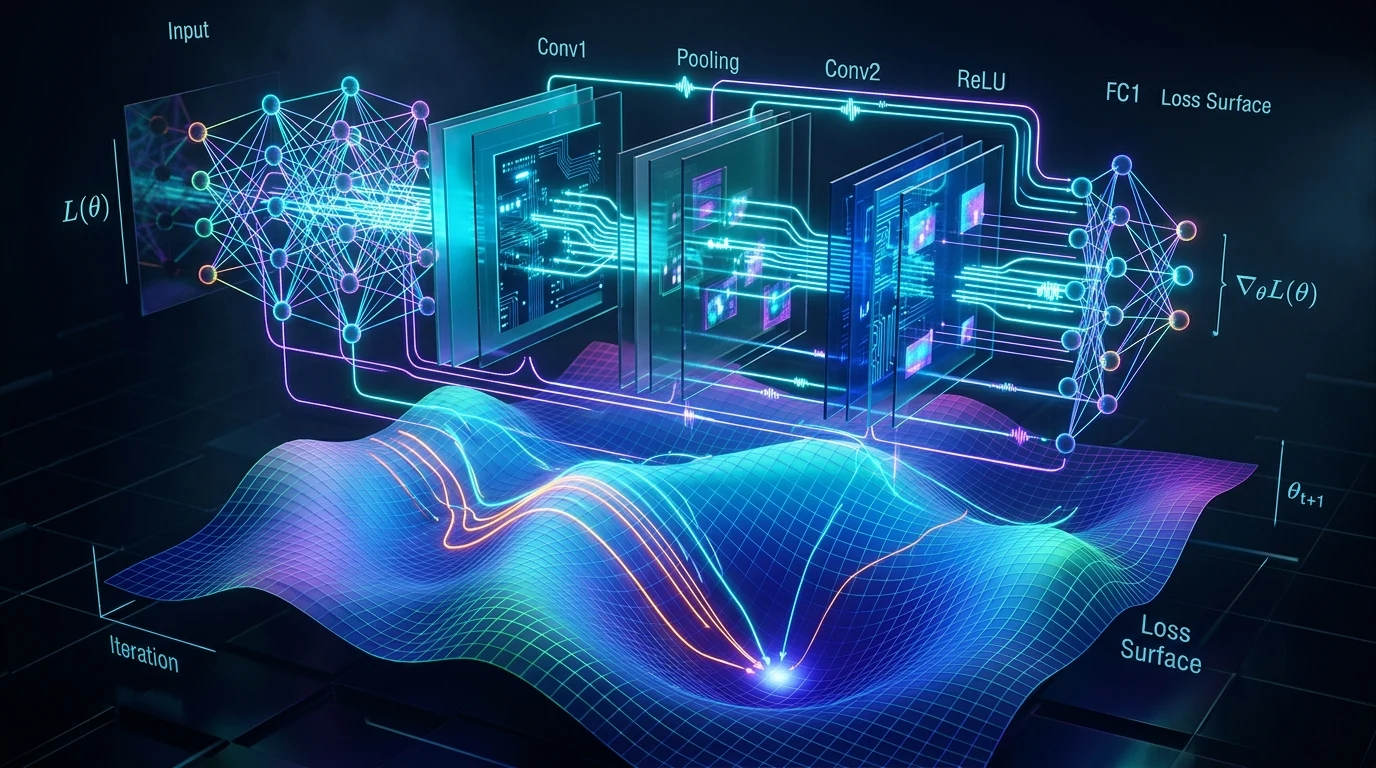
- Deep PyTorch Programming: Custom autograd modules, loss formulations, and distributed multi-GPU training.
- Model Compression: Pruning, INT8/FP16 quantization, and ONNX Runtime compilation for ultra-fast serving.
- Automated MLOps: Feature store pipelines with Feast, model tracking with MLflow, and CI/CD retraining with Kubeflow.
Industry Aligned Curriculum
Progress from foundational mathematics and PyTorch internals to enterprise computer vision, feature stores, and automated production serving.
Mathematical Foundations & Deep Learning with PyTorch
- Matrix factorizations, SVD & Eigenvalues
- Multivariate gradient descent & Backpropagation
- Cross-entropy, Focal loss & regularizations
- Tensors, Autograd & computational graph flow
- Custom Dataset, DataLoader & memory pinners
- PyTorch Lightning clean abstractions
- AdamW, RMSprop & learning rate schedulers
- Batch Normalization vs. Layer Normalization
- Dropout, weight decay & gradient clipping
Computer Vision, Convolutional Architectures & Object Detection
- Convolution operations, kernels & receptive fields
- ResNet skip connections & identity mapping
- EfficientNet compound scaling techniques
- Single-stage detectors: YOLOv8 / YOLOv9
- Anchor boxes, IoU metrics & Non-Max Suppression
- Semantic & Instance segmentation with Mask R-CNN
- Patch embeddings & spatial self-attention
- Swin Transformer hierarchical representations
- Transfer learning & fine-tuning on domain imagery
Sequence Modeling, NLP & Recommendation Architectures
- Word2Vec to BERT contextual representations
- Hugging Face tokenizers & sequence classifiers
- Named Entity Recognition (NER) & text similarity
- Two-Tower Deep Neural Networks (User & Item)
- Approximate Nearest Neighbors (ANN) indexing
- Negative sampling strategies & ranking loss
- LSTM, GRU & Temporal Fusion Transformers (TFT)
- Seasonality decomposition & stationary tests
- Cross-validation for sequential temporal datasets
Model Serving, Quantization (TensorRT) & MLOps Infrastructure
- Feast Feature Store integration (Online Redis / Offline)
- Point-in-time correctness to prevent data leakage
- Kafka streaming feature ingestion
- ONNX Runtime export & graph optimizations
- TensorRT FP16/INT8 post-training quantization
- Triton Inference Server deployment with dynamic batches
- MLflow experiment tracking & model governance
- Evidently AI for distribution drift detection
- Automated CI/CD retraining workflows on Kubernetes
Enterprise-Grade Major Live Projects
Engineer resilient, scalable systems that mirror architectures used at leading technology and enterprise companies.
Real-Time Two-Tower Product Recommendation Engine
Trained on millions of user clickstream events. Employs deep user/item representations with Milvus vector search, integrated Feast feature store, and sub-15ms personalized candidate ranking served via Triton.
Edge-Optimized Industrial Quality Inspection System
High-speed defect detection using custom YOLOv9 architecture. Compiled to TensorRT FP16, executing on NVIDIA Jetson edge nodes at 60 FPS with automated visual inspection logs streaming to AWS S3.
Automated Continuous Retraining Fraud Detection Engine
Real-time transaction fraud scoring with LightGBM and deep autoencoders. Employs Kafka streaming features, Evidently AI drift monitoring, and an automated GitHub Actions & Kubeflow retraining pipeline.
Production Tools You Will Master
Comprehensive training in the standard industry stack required by enterprise machine learning and computer vision teams.
Who Is This Specialization Built For?
Tailored for developers, analysts, and engineers ready to build production-level deep learning and machine learning systems.
Advancing to ML Engineer
Convert your software engineering and coding capabilities into deep learning, model deployment, and high-performance inference skills.
Transitioning to Applied AI
Move beyond dashboards and basic statistical models to master PyTorch, computer vision, and scalable machine learning workflows.
Specializing in MLOps Engineering
Combine your Kubernetes and CI/CD background with Feast feature stores, Triton inference servers, and automated model tracking.
Apply for Upcoming 2026 Batch
Complete your evaluation details below. An admissions advisor will connect with you within 15 minutes with the full curriculum kit and batch schedule.
Find Your Preferred Learning Location
Explore verified training hubs across Delhi NCR and India's prime tech corridors offering interactive live mentor labs, classroom options, and dedicated career placement support.
Frequently Asked Questions
Detailed answers regarding technical stack, GPU allocations, and career outcomes.